You all may recall the days when newspapers screamed accounts of the US government spending hundreds or thousands of dollars on mundane items like hammers and toilet sets that are available at the local Home Depot for a fraction of the price.
It's too bad that we see the same expenses in aviation, yet without there being a ready alternative.
Case in point: The electric pitch trim switch in Mike Hotel could stand to be replaced. It works fine for nose down pitch, but is very intermittent for nose up pitch. So, we asked the avoinics tech if he could fix it which the rest of the panel is torn apart.
Of course he can. The only hiccup is that a new pitch trim switch is -- get this -- $800. That's right, a relatively simple SPDT thumb switch, available at your local Radio Crack for under $10, will cost $800 because it's being installeed in an airplane.
As an alternative, we can get a used switch from the junkyard. That's a bargain at $400, except it comes with no warranty. I.e, no guarantee that it will actually work...
Thursday, March 29, 2007

Wednesday, March 28, 2007


Yeah Baby!
The avionics tech reports that our current altitude encoder does, in fact, have digital output that can properly interface with the MX-20. So, we don't need that little extra added to the final bill!
Hoping we can get some pictures to enliven these boring little posts.
Hoping we can get some pictures to enliven these boring little posts.
Tuesday, March 27, 2007
The Law of Unintended Consequences a/k/a The Great GPS Swap, Update #1
You all know the drill. You bring your car in for a $20 oil change; $100 later, you got an oil change, plus tire rotation, plus, plus, plus. And for dessert, you get a pallet of additional recomended fixes that will break the bank. So you avoid servicing your car.
What makes you think it's any different with a vehicle that moves in three dimensions?
Mike Hotel is in the shop for The Great GPS Swap. So far, this has entailed, in addition to the contracted-for work:
I see this and say, "That's going to cost a lot of money..."
And, we still need an oil change. It's good to be an aircraft owner, isn't it?
What makes you think it's any different with a vehicle that moves in three dimensions?
Mike Hotel is in the shop for The Great GPS Swap. So far, this has entailed, in addition to the contracted-for work:
- Repairs to transponder wiring.
- Possible replacement of a COM antenna.
- Installation of an altitutde converter so that the 430 can properly report altitude to the MX-20.
- Removal and repair of the MX-20 to correct lines on the display.
- Installation of a (used) glideslope splitter so that the 430 can handle ILS approaches.
- Permanent installation of antenna and power wires for the 396.
- Installation of a data line between the 430 and the 396 so that flight plans will automatically upload from the former to the latter.
I see this and say, "That's going to cost a lot of money..."
And, we still need an oil change. It's good to be an aircraft owner, isn't it?
Sunday, March 25, 2007
We're Back!
MS and the IFR Pilot have returned from a glorious trip. A full report will follow after laundry is done, house is cleaned, and pictures are downloaded.
But here's a preview:
Thursday afternoon: Home Base to Nashville, TN. 1.5 hours hard IFR, headwinds. Should have ordered the ribs like everyone else.
Friday: Nashville, TN to Panama City, FL. Hooters. Golf. Beer. Trouble all around.
Saturday: Attempted Air Show. Totally FUBAR. What? New Orleans is only two hours away? We're outta here.
Saturday afternoon: Muffalatas on the levee. Drinks and live jazz in the Quarter. Way too much steak at Crazy Johnny's. Stop at store and buy as much Abita beer as Mike Hotel can hold when it already has clothes, golf clubs, art purchased in the gallery, etc.
Sunday: Dammit Millionaire, we said "fuel it to the TABS." That does NOT mean "fill it to the tops." Drain that NOW. A shame to waste 100LL. IFR from Lakefront to RNC. $2.99 100LL. VFR to the Home Base.
Whew, that's a massive amount of shenanigans in 3.5 days. But, no money was spent on bail, so I suppose that's a good thing.
Mike Hotel goes in for the Great GPS Swap tomorrow, so this should also prove to be an adventure-filled week.
But here's a preview:
Thursday afternoon: Home Base to Nashville, TN. 1.5 hours hard IFR, headwinds. Should have ordered the ribs like everyone else.
Friday: Nashville, TN to Panama City, FL. Hooters. Golf. Beer. Trouble all around.
Saturday: Attempted Air Show. Totally FUBAR. What? New Orleans is only two hours away? We're outta here.
Saturday afternoon: Muffalatas on the levee. Drinks and live jazz in the Quarter. Way too much steak at Crazy Johnny's. Stop at store and buy as much Abita beer as Mike Hotel can hold when it already has clothes, golf clubs, art purchased in the gallery, etc.
Sunday: Dammit Millionaire, we said "fuel it to the TABS." That does NOT mean "fill it to the tops." Drain that NOW. A shame to waste 100LL. IFR from Lakefront to RNC. $2.99 100LL. VFR to the Home Base.
Whew, that's a massive amount of shenanigans in 3.5 days. But, no money was spent on bail, so I suppose that's a good thing.
Mike Hotel goes in for the Great GPS Swap tomorrow, so this should also prove to be an adventure-filled week.
Wednesday, March 21, 2007
Doggone It
Well, I'll say this for Flying: At least they are prompt in responding. They passed on the RITTRs article, though they were kind enough to describe it as "very well written and informative," just not something they have a need for right now.
Must. Keep. Trying.
Must. Keep. Trying.


RITTRs Article
Strangely, AOPA Pilot didn't drop everything to promptly respond that they were dying for my article on RITTRs. In fact, I've received no word at all. So, yesterday I submitted it to Flying and Plane & Pilot. Perhaps one of them will be dying to publish my first freelance aviation article!
Sunday, March 18, 2007
Narcissism, Thy Name Is
MS finally got off his duff and forwaded the pictures from our recent jaunt to BKL. Here they are for your viewing pleasure, please excuse the indulgence in posting pictures of your trusty narrator. Per MS, "I'm sick of being the only person in photos on your blog. Post. Pictures. Of. YOURSELF."
Roger that, captain.
 Short Final for BKL's Runway 24R.
 Your Trusty Narrator Gettin' His PIC On.
 Very Short Final, BKL 24R.
 Guess Who?
 Here's A Hint...
 Crosswind Over A Slightly Frozen Lake Erie.
 A Even More Frozen Lake Erie.
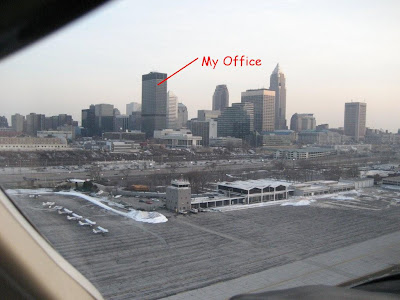 C-Town In All Its Glory.
See why I get distracted at work?
Roger that, captain.
 Short Final for BKL's Runway 24R.
 Your Trusty Narrator Gettin' His PIC On.
 Very Short Final, BKL 24R.
 Guess Who?
 Here's A Hint...
 Crosswind Over A Slightly Frozen Lake Erie.
 A Even More Frozen Lake Erie.
 C-Town In All Its Glory.
 See why I get distracted at work?
Wednesday, March 14, 2007
Night Recap
Needed a total of 1.5 hours, and got 1.7. Total night solo hours: 5.3. We're covered for the commercial!
First destination was New Philly. Needed to drop off the 430 and accessories to the folks that will be doing the upgrades in the next couple weeks, so this was a good way to avoid more postage and insurance charges! It was very calm in the air despite reports of slight to moderate turbulence below 8000 feet.
But the winds were powerful out of the west, between 30 and 40 knots. That made the first attempt at landing a bit of a challenge, and I ended up going around rather than try to make an excessive turn on final to realign with the runway. Just need to avoid those hills over there to the east of PHD....
Second time's the charm, helps to use a HUGE cross-wind correction on downwind and extend it a bit. A long final approach is OK by me. Use that VASI on the left, get two white, two red, over the numbers, ahhhhhh, that's it, down and safe. Taxi to park and drop off the big box that was in the back seat.
Chatted with a local for a while, he cautioned to watch out for deer on the end of runway 32. Suggested a back taxi to ensure the runway was clear, so I took that advice. Nope, no venison in sight. We're outta here!
Off to the west, hello headwinds. What's that? 90 knot ground speed? C'mon, we can do better than that? Ohh, hello 105 knots. Well, that's the best we're gonna get with that direct headwind.
No matter, cleared to land runway 23 from 5 miles out. Left base, gear down, flaps down, align that VASI. Uh-oh, excessive sink rate, add power. Hmm, more power. Hmmm, even more power? Note: Climb power should not be used on final approach, hold off on the last 10 degrees of flaps next time!
Down and stop, Tower calls "Welcome to Mansfield." Thanks, want to tell me why the Flying Turtle is closed until further notice? No $100 breakfasts this Spring I guess.
Takeoff, left turn, head for the Home Base. Yeah, baby, that headwind is now a 40 knot tailwind! Wahooooooooooo!
Over the Salt Shaker, 45 to left downwind 21, level 2000 feet. Gear down, smooth application of the flaps, over the trees (WHEN ARE THEY GOING TO TRIM THE TREES????), cut the power, thunk we're down and home.
Taxi to the hangar. Ouch, I'm stuck in the mud. MS is going to make me clean the plane, I bet...
Now, only an hour drive until I can lay my head down and rest after a long, long day.
First destination was New Philly. Needed to drop off the 430 and accessories to the folks that will be doing the upgrades in the next couple weeks, so this was a good way to avoid more postage and insurance charges! It was very calm in the air despite reports of slight to moderate turbulence below 8000 feet.
But the winds were powerful out of the west, between 30 and 40 knots. That made the first attempt at landing a bit of a challenge, and I ended up going around rather than try to make an excessive turn on final to realign with the runway. Just need to avoid those hills over there to the east of PHD....
Second time's the charm, helps to use a HUGE cross-wind correction on downwind and extend it a bit. A long final approach is OK by me. Use that VASI on the left, get two white, two red, over the numbers, ahhhhhh, that's it, down and safe. Taxi to park and drop off the big box that was in the back seat.
Chatted with a local for a while, he cautioned to watch out for deer on the end of runway 32. Suggested a back taxi to ensure the runway was clear, so I took that advice. Nope, no venison in sight. We're outta here!
Off to the west, hello headwinds. What's that? 90 knot ground speed? C'mon, we can do better than that? Ohh, hello 105 knots. Well, that's the best we're gonna get with that direct headwind.
No matter, cleared to land runway 23 from 5 miles out. Left base, gear down, flaps down, align that VASI. Uh-oh, excessive sink rate, add power. Hmm, more power. Hmmm, even more power? Note: Climb power should not be used on final approach, hold off on the last 10 degrees of flaps next time!
Down and stop, Tower calls "Welcome to Mansfield." Thanks, want to tell me why the Flying Turtle is closed until further notice? No $100 breakfasts this Spring I guess.
Takeoff, left turn, head for the Home Base. Yeah, baby, that headwind is now a 40 knot tailwind! Wahooooooooooo!
Over the Salt Shaker, 45 to left downwind 21, level 2000 feet. Gear down, smooth application of the flaps, over the trees (WHEN ARE THEY GOING TO TRIM THE TREES????), cut the power, thunk we're down and home.
Taxi to the hangar. Ouch, I'm stuck in the mud. MS is going to make me clean the plane, I bet...
Now, only an hour drive until I can lay my head down and rest after a long, long day.
Commercial Pilot Flight Experience Requirements -- 2007 First Update
Current as of 3/13/2007 (bold = done, red=working on it):
Looks like we're ready to start the flight training with the CFI. Saturday at 2:00, first lesson.
- At least 250 hours of flight time as a pilot that consists of at least:
- 100 hours in powered aircraft, of which 50 hours must be in airplanes
- 100 hours as pilot in command flight time, which includes at least:
- 50 hours in airplanes
- 50 hours in cross-country flight of which at least 10 hours must be in airplanes
- 20 hours of training in the areas of operation listed below, including at least:
- 10 hours of instrument training of which at least 5 hours must be in a single-engine airplane
- 10 hours of training in an airplane that has a retractable landing gear, flaps, and controllable pitch propeller, or is turbine-powered
- One cross-country flight of at least 2 hours in a single-engine airplane in day-VFR conditions, consisting of a total straight-line distance of more than 100 NM from the original point of departure
- One cross-country flight of at least 2 hours in a single-engine airplane in night-VFR conditions, consisting of a straight-line distance of more than 100 NM from the original point of departure
- 3 hours in a single-engine airplane in preparation for the practical test within the 60 days preceding the test
- 10 hours of solo flight in a single-engine airplane training in the areas of operation required for a single-engine rating, which includes at least:
- One cross-country flight of not less than 300 NM total distance, with landings at a minimum of three points, one of which is a straight-line distance of at least 250 NM from the original departure point
- 5 hours in night-VFR conditions with 10 takeoffs and 10 landings (with each landing involving a flight in the traffic pattern) at an airport with an operating control tower
- Current total night solo hours: 5.3 hours
- 1/26/06 - .4 hours
- 3/29/06 - .7 hours
- 4/10/06 - 1.4 hours
- 10/2/06 - 1.1 hours
- 3/13/07 - 1.7 hours
- Current total night solo takeoffs and landings at controlled airport: 11
- 3/29/06 - 3 takeoffs and landings at CAK
- 4/10/05 - 3 takeoffs and landings at MFD and 3 at CAK
- 10/2/06 - 2 takeoffs and landings at CAK
Looks like we're ready to start the flight training with the CFI. Saturday at 2:00, first lesson.
Tuesday, March 13, 2007
Night, Night, Night
In an effort to complete the 1.5 hours of night solo time still needed for the commercial, the IFR Pilot is planning on hitting the airport tonight. To make sure that the time is legally night within the meaning of the applicable FAR, it must be one hour after the end of evening civil twlight, as published in the American Air Almanac. Since I didn't have one of those handy on the corner of my desk, I resorted to the next best thing: The Internet.
Go here and you too can determine with scientific precision when your flight counts as "night."
Go here and you too can determine with scientific precision when your flight counts as "night."
Saturday, March 10, 2007
The ATs
I'm coining a new term: Aviation Tremens. Its symptoms are related to Delirum Tremens, aka "the DTs." It's a horrible disease that afflicts aviators who are subject to long winters with unpredictable weather patterns that make it an uphill challenge at best to satisfy their aviation addiction. So, we'll call it the "ATs."
Yesterday, the IFR Pilot was a victim. High pressure moved into Northern Ohio early yesterday, by itself not a novel occurrence. But this was coupled with the jet stream moving north, allowing warmer air to move up from the Gulf. As a result, we had clear skies, nearly unlimited visibility, and temperatures in the high-40's to mid-50's.
I was sitting at my desk, trying to pound out paperwork to assail my litigation opponents. Continually distracted by the view outside my window of BKL and Lake Erie. All I could think about was Mike Hotel, safely ensconced in the hangar, just waiting to be put to the rigors of flight. Would my weekend schedule permit me to fly? Hmmmm, let's see.
Nope, that'll be an uphill challenge at best. Tentatively, MS and I planned a Sunday afternoon rendezvous. A couple hours later, still distracted, yet trying to focus, I was daydreaming while admiring a takeoff out the window.
"You want to go flying, don't you?" It was the voice of my trusted and faithful assistant, she who keeps me from committing more faux pas than I should acknowledge.
"What make you say that?", I ask, in my most professional lawyer/boss voice.
"I see that glaze over your eyes, that wistful look. You should go. We've got things under control here."
"I don't know, there's a pile of junk sitting here waiting to be done."
"It'll be there when you get back. Go fly and satisfy your addiction. And remember, I won't be here Monday."
A seasoned boss, I am, I always listen to the judgment of my assistant. So I shut down the laptop and bid adieu to the prison that is my weekday office.
En route, I make the predictable call.
"Dude, c'mon let's go fly," I demand of MS, who is equally slaving away to The Man.
"Can't, got plans at 7:00."
"No problem, I'll pick you up at Medina, we'll putz around for an hour or so, I'll drop you off in time for your get together."
"Done. See you in an hour."
"Roger that!"
So, I speed off to the hangar. Honoring my recent vow, and despite the CAVU weather, I called and got a weather briefing. As expected, the weather briefing was a non-event. I did, however, for the first time ask if there were any NOTAMs for predicted lack of RAIM availability. We've been seeing quite a bit of those errors on the 396 lately, so I'm trying to incorporate this into my standard retinue of questions to ask. The briefer advised of no such NOTAMs, but did offer that there were some NOTAMs regarding "pseudo-random noise." (I need to look into that; might be a good idea for a post/article.)
Mike Hotel had what appeared to be a smile on the cowl as I undid the Aerotherm heater and opened the hangar. After a preflight, I blasted off for Medina. It's all of about a 3 minute flight, so my hands were a bit full. All went well, but aviators landing on Runway 19 at 1G5 must remember that the threshold is significantly displaced. Here's my key: Over the wires with the orange balls, chop the power, you'll be fine. Demonstrating that self-confidence is a danger to aviators everywhere, I bounced the landing. Can I log both of those?
(As I taxied to the ramp I did not, repeat not see MS fall into the mud. He's waaaaaay too coordinated to pull such a stunt, something that more often would befall me. And there's no, I repeat no, mud to be cleaned from the wingwalk and footwells of the airplane.)
First order of business, make MS perform a takeoff and landing from the right seat. Just for the hey-hey of it. He did fine, no doubt knowing that the IFR Pilot had hands on the controls, ready to rescue us should impending doom reach out to grab us. He too gets to log two landings from one trip around the pattern.
With time on our hands, we did the only just and proper thing: Head up to Burke and enjoy the scenery. So that's what we did.
Cleveland Approach gave us a vector to avoid landing traffic, but soon advised that if we descended, we could proceed direct. One guess at what we did.
Over the Valley View Bridge, we had Lakefront in sight and got a frequency change. It was child's play at that point. Enter on a left base for 24L, then request 24R, which we got. A bit high over the water, just in case, and then cut the power, drop 'er in, and we're on the ground.
A strange sensation in my left butt cheek worried me that maybe the left tire didn't agree with my assessment of the landing. So, we taxied to the ramp just to see if there was anything amiss. MS was right, no problem with the tire, was probably just the brake sticking and releasing. But we took the opportunity to take some photos (to be posted here later after MS forwards then), and switch seats.
MS handled the flying back to Medina, and the IFR Pilot had the radios. After 20 minutes or so, we were on a long final for straight-in to Runway 19 at 1G5. Threw the lights on and that helped us discern the displaced threshold from several miles. MS greased it in, so he only got to log one landing that time.
A quick switcharoo, and I blasted off for the return to the Home Base. Another 3 minute flight.
After several tries to turn the lights on, I realize I've got 123.50 in the radio, not 123.05. Oops, dyslexia at the wrong moment. No wonder I'm not getting any action! Finally, they come on, I cross over the top for left downwind to 21. Looking for a good landing this time to make up for the poor showing at Medina, it all comes together and as I enter the flare, the stall horn goes off and the wheels give the runway the lightest of kisses, like those you give your sleeping lover as you dash off to work and their slumbering continues.
After landing and throwing some gas in the tanks so that next time, we're ready to go without the hassle of fueling up, I notice the upturn in my disposition and an end to the ATs.
Kids, does it get any better than that? Now, I gotta get dressed and go to work!!!
Yesterday, the IFR Pilot was a victim. High pressure moved into Northern Ohio early yesterday, by itself not a novel occurrence. But this was coupled with the jet stream moving north, allowing warmer air to move up from the Gulf. As a result, we had clear skies, nearly unlimited visibility, and temperatures in the high-40's to mid-50's.
I was sitting at my desk, trying to pound out paperwork to assail my litigation opponents. Continually distracted by the view outside my window of BKL and Lake Erie. All I could think about was Mike Hotel, safely ensconced in the hangar, just waiting to be put to the rigors of flight. Would my weekend schedule permit me to fly? Hmmmm, let's see.
Nope, that'll be an uphill challenge at best. Tentatively, MS and I planned a Sunday afternoon rendezvous. A couple hours later, still distracted, yet trying to focus, I was daydreaming while admiring a takeoff out the window.
"You want to go flying, don't you?" It was the voice of my trusted and faithful assistant, she who keeps me from committing more faux pas than I should acknowledge.
"What make you say that?", I ask, in my most professional lawyer/boss voice.
"I see that glaze over your eyes, that wistful look. You should go. We've got things under control here."
"I don't know, there's a pile of junk sitting here waiting to be done."
"It'll be there when you get back. Go fly and satisfy your addiction. And remember, I won't be here Monday."
A seasoned boss, I am, I always listen to the judgment of my assistant. So I shut down the laptop and bid adieu to the prison that is my weekday office.
En route, I make the predictable call.
"Dude, c'mon let's go fly," I demand of MS, who is equally slaving away to The Man.
"Can't, got plans at 7:00."
"No problem, I'll pick you up at Medina, we'll putz around for an hour or so, I'll drop you off in time for your get together."
"Done. See you in an hour."
"Roger that!"
So, I speed off to the hangar. Honoring my recent vow, and despite the CAVU weather, I called and got a weather briefing. As expected, the weather briefing was a non-event. I did, however, for the first time ask if there were any NOTAMs for predicted lack of RAIM availability. We've been seeing quite a bit of those errors on the 396 lately, so I'm trying to incorporate this into my standard retinue of questions to ask. The briefer advised of no such NOTAMs, but did offer that there were some NOTAMs regarding "pseudo-random noise." (I need to look into that; might be a good idea for a post/article.)
Mike Hotel had what appeared to be a smile on the cowl as I undid the Aerotherm heater and opened the hangar. After a preflight, I blasted off for Medina. It's all of about a 3 minute flight, so my hands were a bit full. All went well, but aviators landing on Runway 19 at 1G5 must remember that the threshold is significantly displaced. Here's my key: Over the wires with the orange balls, chop the power, you'll be fine. Demonstrating that self-confidence is a danger to aviators everywhere, I bounced the landing. Can I log both of those?
(As I taxied to the ramp I did not, repeat not see MS fall into the mud. He's waaaaaay too coordinated to pull such a stunt, something that more often would befall me. And there's no, I repeat no, mud to be cleaned from the wingwalk and footwells of the airplane.)
First order of business, make MS perform a takeoff and landing from the right seat. Just for the hey-hey of it. He did fine, no doubt knowing that the IFR Pilot had hands on the controls, ready to rescue us should impending doom reach out to grab us. He too gets to log two landings from one trip around the pattern.
With time on our hands, we did the only just and proper thing: Head up to Burke and enjoy the scenery. So that's what we did.
Cleveland Approach gave us a vector to avoid landing traffic, but soon advised that if we descended, we could proceed direct. One guess at what we did.
Over the Valley View Bridge, we had Lakefront in sight and got a frequency change. It was child's play at that point. Enter on a left base for 24L, then request 24R, which we got. A bit high over the water, just in case, and then cut the power, drop 'er in, and we're on the ground.
A strange sensation in my left butt cheek worried me that maybe the left tire didn't agree with my assessment of the landing. So, we taxied to the ramp just to see if there was anything amiss. MS was right, no problem with the tire, was probably just the brake sticking and releasing. But we took the opportunity to take some photos (to be posted here later after MS forwards then), and switch seats.
MS handled the flying back to Medina, and the IFR Pilot had the radios. After 20 minutes or so, we were on a long final for straight-in to Runway 19 at 1G5. Threw the lights on and that helped us discern the displaced threshold from several miles. MS greased it in, so he only got to log one landing that time.
A quick switcharoo, and I blasted off for the return to the Home Base. Another 3 minute flight.
After several tries to turn the lights on, I realize I've got 123.50 in the radio, not 123.05. Oops, dyslexia at the wrong moment. No wonder I'm not getting any action! Finally, they come on, I cross over the top for left downwind to 21. Looking for a good landing this time to make up for the poor showing at Medina, it all comes together and as I enter the flare, the stall horn goes off and the wheels give the runway the lightest of kisses, like those you give your sleeping lover as you dash off to work and their slumbering continues.
After landing and throwing some gas in the tanks so that next time, we're ready to go without the hassle of fueling up, I notice the upturn in my disposition and an end to the ATs.
Kids, does it get any better than that? Now, I gotta get dressed and go to work!!!
Thursday, March 08, 2007
Ouch.
Today, the IFR Pilot is glad that, unlike other fellow aviation bloggers, he doesn't live in the Wild Republic of Minnesota. As the AOPA website first noted, a bill in the Minnestoa legislature would work some marked changes on the insurance landscape in the Land of a Thousand Lakes.
In pertient part, that bill states:
In the interest of full, disclosure, however, I note that to some extent we already deal with the rule of absolute liability in aviation:
Thus, if there is an incident involving an aircraft covered by a policy subject to this legislation, courts will no longer engage in any inquiry as to who might be at fault. Your insurance company pays, no questions asked. You can bet what this will do to rates, not just in Minnesoata, but for all of us.
We've all got a stake in this one. Just say no to Minnesota Senate File 608!
In pertient part, that bill states:
Every owner of aircraft in this state when applying for registration, reregistration, or transfer of ownership shall supply any information the commissioner reasonably requires to determine that the aircraft during the period of its contemplated operation is covered by an insurance policy with limits of not less thanSo, beyond raising the minimum coverage levels by a whopping 10 fold, the bill now imposes a cateogory of liability usually reserved for ultrahazardous or abnormally dangerous activities: "absolute liability." Here's how my trusty Black's Law Dictionary defines the concept of absolute liability: "Liability without fault of negligence." In the past, absolute liability has been reserved for matters such as pile driving, poisonous gases, rockets, hazardous waste disposal sites, oil wells, and escaping water.$25,000$250,000 per passenger seat liability both for passenger bodily injury or death and for property damage; not less than$25,000$250,000 for bodily injury or death to each nonpassenger in any one accident; and not less than$50,000$500,000 per occurrence for bodily injury or death to nonpassengers in any one accident. The insurance policy is subject to the following, which need not be contained in the policy:
(1) the liability of the insurer with respect to the liability coverage required by this subdivision becomes absolute whenever injury or damage occurs;
(2) the liability of the insurer may not be canceled or annulled by any agreement between the insurer and the insured after the occurrence of the injury or damage; and
(3) no statement made by the insured or on the insured's behalf and no violation of the policy defeats or voids the policy.
In the interest of full, disclosure, however, I note that to some extent we already deal with the rule of absolute liability in aviation:
In the early stages of commerical aviation, airlines were held strictly liable for ground damage resulting from a crash. This view is no longer justified by the character of the planes and their accident records if the basis is an ultrahazardous or abnormally dangerous activity; and a number of courts have retreated to a negligence standard. * * * After considerable wavering by the American Law Institute, a rule of strict liability was adopted in § 520A of the Second Restatement [of Torts].Prosser, Wade & Schwartz, Torts: Cases & Materials 686-87 (8th ed. 1988). The referenced § 520A of the Restatement (Second) of Torts provides as follows:
GROUND DAMAGE FROM AIRCRAFT
If physical harm to land or to persons or chattels on the ground is caused by the ascent, descent or flight of aircraft, or by the dropping or falling of an object from the aircraft,
(a) the operator of the aircraft is subject to liability for the harm, even though he has exercised the utmost care to prevent it, and
(b) the owner of the aircraft is subject to similar liability if he has authorized or permitted the operation.
Thus, if there is an incident involving an aircraft covered by a policy subject to this legislation, courts will no longer engage in any inquiry as to who might be at fault. Your insurance company pays, no questions asked. You can bet what this will do to rates, not just in Minnesoata, but for all of us.
We've all got a stake in this one. Just say no to Minnesota Senate File 608!
Monday, March 05, 2007
Upgrades Are Coming
Looks like Mike Hotel will be undergoing some changes in the near future.
No, we're not selling.
But we've got a tenative plan to dump the Apollo/UPSAT GX-50 GPS and one of the MAC-1700 radios in favor of a Garmin 430 installation, similar to what we had on 78S. Neither MS nor I have been particularly happy with the way the GX-50 operates on GPS approaches, the lack of ILS overlays for situational awareness, and the handling of holds. Despite both of our best efforts to master it, we just plain don't like it.
So, with some digging and creative financing, it appears that we've found a way to upgrade without breaking the bank.
Now, y'all need to do your part: Anyone want a gently-used but completely functional GX-50 (including an extra data card!) or MAC-1700???
No, we're not selling.
But we've got a tenative plan to dump the Apollo/UPSAT GX-50 GPS and one of the MAC-1700 radios in favor of a Garmin 430 installation, similar to what we had on 78S. Neither MS nor I have been particularly happy with the way the GX-50 operates on GPS approaches, the lack of ILS overlays for situational awareness, and the handling of holds. Despite both of our best efforts to master it, we just plain don't like it.
So, with some digging and creative financing, it appears that we've found a way to upgrade without breaking the bank.
Now, y'all need to do your part: Anyone want a gently-used but completely functional GX-50 (including an extra data card!) or MAC-1700???
Wednesday, February 28, 2007
The Underbelly of the Beast
Today was a first for the IFR Pilot. Seven-plus hours were spent crawling over the wreckage of a single-engine plane that, along with its owner, came to an ignominious end. It's in litigation, and we help represent one of the allegedly liable parties. Thus, I won't be sharing any details about the crash itself or the lawsuit, even though it's a matter of public record.
I was prepared for this to be an eye-opening experience. I've written numerous times about crashes in various Accident of the Week posts (note to self: start writing those again!). In general, it's an academic exercise, done principally for me to (a) have something to write about, and (b) to consider various situations and think actively about what I might do if ever presented with a similar scenario. I've been blessed that I have yet to know personally anyone who met their maker while flying, although the Vari-Eze crash in Lethbridge during The Great Alaska Adventure (tm) was close enough. But this was my first time up-close and personal crawling around what's left of a plane that smacked into the ground. Mind you, I'm only just the lawyer who dabbles in aviation. There was a roomful of experts to do the real investigating.
I had steeled myself for the experience of seeing the crumpled mass of aluminium, wires, and equipment that was once an airplane. I particularly dreaded the prospect of seeing any lingering blood from the pilot. It would be an all-too-acute reminder that, for once, this wasn't just an academic exercise. It was real, with tangible effects for all involved.
Turns out that the latter fear was misplaced. There was no sign of blood, probably because most of the instrument panel had been removed during a previous inspection.
So, all was good for a while. It started to became another somewhat academic exercise. Taking in the various things that the people whose business accident reconstruction is were saying. Really, it's amazing to see how they can deduce, infer, and postulate about what was happening based on various dents, scratches, and the like.
The reality that someone had perished in this aircraft, however, was brought back with a vengeance in the blink of an eye. While moving some wires and other items in the cockpit, I came across a blue nitrile glove. Now, maybe it was deposited there during a prior inspection. In the instant that I saw it, however, all I could think was that it was left there when EMS responded to the scene of the crash and learned that nothing could be done for the pilot.
Faithful readers, we all accept the proposition that there is risk in aviation. Just like there is risk in anything else we choose to do in life, whether it's skydiving or crossing the street.
As I confided in one of our experts, however, I don't ever want a dozen or more lawyers, engineers, and accident reconstruction experts combing over the wreckage of an aircraft that I was piloting. Ever.
No, I'm not giving up the aviation game. I am, however, redoubling my commitment to be a safe pilot, whether flying solo or with others aboard. No more abbreviated pre-flight inspections. No more skipping calling for a weather briefing, even if I've gotten a computer briefing. More rigorous scanning for traffic, both as PIC and safety pilot. More regular perusal of Mike Hotel's POH so that I can know everything about the plane that I'm flying. All the little things that I can do to try and minimize risk.
Won't you all do the same, so that someday I don't have to comb through your wreckage too?
I was prepared for this to be an eye-opening experience. I've written numerous times about crashes in various Accident of the Week posts (note to self: start writing those again!). In general, it's an academic exercise, done principally for me to (a) have something to write about, and (b) to consider various situations and think actively about what I might do if ever presented with a similar scenario. I've been blessed that I have yet to know personally anyone who met their maker while flying, although the Vari-Eze crash in Lethbridge during The Great Alaska Adventure (tm) was close enough. But this was my first time up-close and personal crawling around what's left of a plane that smacked into the ground. Mind you, I'm only just the lawyer who dabbles in aviation. There was a roomful of experts to do the real investigating.
I had steeled myself for the experience of seeing the crumpled mass of aluminium, wires, and equipment that was once an airplane. I particularly dreaded the prospect of seeing any lingering blood from the pilot. It would be an all-too-acute reminder that, for once, this wasn't just an academic exercise. It was real, with tangible effects for all involved.
Turns out that the latter fear was misplaced. There was no sign of blood, probably because most of the instrument panel had been removed during a previous inspection.
So, all was good for a while. It started to became another somewhat academic exercise. Taking in the various things that the people whose business accident reconstruction is were saying. Really, it's amazing to see how they can deduce, infer, and postulate about what was happening based on various dents, scratches, and the like.
The reality that someone had perished in this aircraft, however, was brought back with a vengeance in the blink of an eye. While moving some wires and other items in the cockpit, I came across a blue nitrile glove. Now, maybe it was deposited there during a prior inspection. In the instant that I saw it, however, all I could think was that it was left there when EMS responded to the scene of the crash and learned that nothing could be done for the pilot.
Faithful readers, we all accept the proposition that there is risk in aviation. Just like there is risk in anything else we choose to do in life, whether it's skydiving or crossing the street.
As I confided in one of our experts, however, I don't ever want a dozen or more lawyers, engineers, and accident reconstruction experts combing over the wreckage of an aircraft that I was piloting. Ever.
No, I'm not giving up the aviation game. I am, however, redoubling my commitment to be a safe pilot, whether flying solo or with others aboard. No more abbreviated pre-flight inspections. No more skipping calling for a weather briefing, even if I've gotten a computer briefing. More rigorous scanning for traffic, both as PIC and safety pilot. More regular perusal of Mike Hotel's POH so that I can know everything about the plane that I'm flying. All the little things that I can do to try and minimize risk.
Won't you all do the same, so that someday I don't have to comb through your wreckage too?
Tuesday, February 27, 2007
Live, From the First State
The IFR Pilot is resting comfortably at the Hampton Inn in Dover, Delaware. It was a bit of an adventure getting to Dover, DE:
4:00 leave office
4:30 arrive at local international airpot
4:40 get half naked to prove I'm not a terrorist (editorial: remember when jet travel was glamorous, not borderline demeaning)
4:50 purchase snacks (editorial: remember when you used to get more than 2 small packages of peanuts and a cup of pop?)
5:00 arrive at gate and secure place near the front of the eventual "Group B" departure line
5:50 get called to board
6:00 get allowed on board
6:30 pushback, 10 minutes late
6:32 takeoff
7:16 landing at BWI
8:00 rental car secured
8:20 on the highway
8:40 wish I could see what the Bay Bridge looks like, but it's very, very dark out
8:50 bored, start calling friends on the cell phone, thank goodness for the ear piece
9:30 first wrong turn, quickly corrected
9:45 second wrong turn, not so quickly corrected
10:00 hotel located confirmed
10:10 dinner location secured
11:00 check in
12:00 got to bed
When it should have been:
4:00 leave office
5:00 arrive at The Home Base, preflight and fuel Mike Hotel
5:30 takeoff
8:00 land in Delaware
8:30 taxi drops me off at hotel
9:00 dinner secured
10:30 bed
Oh well. In retrospect, it probably would have been safe to make the flight today. We burst through the clouds in about 15 seconds and were on top until the undercast completely dissipated. Better luck next time.
By the way, Delaware is very, very flat and sparsely populated.
4:00 leave office
4:30 arrive at local international airpot
4:40 get half naked to prove I'm not a terrorist (editorial: remember when jet travel was glamorous, not borderline demeaning)
4:50 purchase snacks (editorial: remember when you used to get more than 2 small packages of peanuts and a cup of pop?)
5:00 arrive at gate and secure place near the front of the eventual "Group B" departure line
5:50 get called to board
6:00 get allowed on board
6:30 pushback, 10 minutes late
6:32 takeoff
7:16 landing at BWI
8:00 rental car secured
8:20 on the highway
8:40 wish I could see what the Bay Bridge looks like, but it's very, very dark out
8:50 bored, start calling friends on the cell phone, thank goodness for the ear piece
9:30 first wrong turn, quickly corrected
9:45 second wrong turn, not so quickly corrected
10:00 hotel located confirmed
10:10 dinner location secured
11:00 check in
12:00 got to bed
When it should have been:
4:00 leave office
5:00 arrive at The Home Base, preflight and fuel Mike Hotel
5:30 takeoff
8:00 land in Delaware
8:30 taxi drops me off at hotel
9:00 dinner secured
10:30 bed
Oh well. In retrospect, it probably would have been safe to make the flight today. We burst through the clouds in about 15 seconds and were on top until the undercast completely dissipated. Better luck next time.
By the way, Delaware is very, very flat and sparsely populated.
Monday, February 26, 2007
Scrubbed
Once again, Momma Nature interferes with the IFR Pilot's plan to use the aircraft for work-related purposes. As a result, I will be jammed into the Cattle Car (otherwise known as Southwest Airlines) for the trip to Baltimore, followed by a 2-hour drive to Delaware. This should be really joyful.
Here's a trivia question for you pundits: Is Delaware the only state in the United States that is not accessible by commercial airline service? To my knowledge, it is.
Update: I was wrong. From the Wikipedia entry for Wilmington, Delaware:
Here's a trivia question for you pundits: Is Delaware the only state in the United States that is not accessible by commercial airline service? To my knowledge, it is.
Update: I was wrong. From the Wikipedia entry for Wilmington, Delaware:
From 1991 through 1998 and again from 2000 to 2006, the state of Delaware was the only state in the union without any scheduled commercial flights in or out of the state. Shuttle America flew out of New Castle as an independent carrier from the airline's founding in November 1998 until February 2000. They offered service to Hartford, Buffalo, and Norfolk, using the 50-seat Dash 8-300 turboprop aircraft. Shuttle America would eventually discontinue its independent operations and become a commuter affiliate of United Express and Delta Connection. Prior to Shuttle America, the last scheduled service was provided to Parkersburg, West Virginia by USAir Express carrier Crown Airways in 1992-1993. United Airlines also served Wilmington, leaving in 1991.
The airport has one terminal, which served only car rental agencies during the time the airport did not have commercial air service. On June 29, 2006, Delta Air Lines began new services from Atlanta's Hartsfield-Jackson Atlanta International Airport to New Castle Airport, making it the first commercial air service in six years. Delta Connection carrier Atlantic Southeast Airlines operates the service using 40-seat CRJ regional jets, with two daily roundtrip flights.
Sunday, February 25, 2007
Knockin' Off The Rust
We convened at the hangar at the appointed time, two junkies ready for their fix. Recalling the last time they defied the law of gravity and took to the sky, this time they resolved to avoid all supercooled large droplets and the pandemonia they brought down on your protagonists.

The new Aero-Therm heater was doing its job quite nicely, and the engine, while not quite warm to the touch, didn't evidence outside temperatures that we still well below OoC. The snow drifts on either side of the hangar apron, however, still needed tending to, so we got our work out there.
After loading 40 gallons of 100LL, we blasted off with MS in the left seat and a brand new pair of $25 Foggles ready for the torture that was to come his way. Being a masochist, we not only wanted all of the flying duties, he wanted the radio duties as well. That left the IFR Pilot to practice his nascent CFI-in-training skills (otherwise known as "harass your partner to no end").

Snow still everywhere, but great visibility:

MS performed suitably well on the ILS 1 at CAK, though his decision to eschew slowing down in favor of flying the approach at 120 knots provided suitable fodder for harassment. Especially when he had trouble staying on the localizer. It's a bit easier when you're moving 30% slower, cappy.
Second time around was a charmer, and we made a touch and go of it. Both passes gave us a nice view of Reverend Ernest Angely's B-747 that is stored on an unused taxiiway at CAK. Rumors to the contrary, televangalism apparently still has its perqs.
Crummy picture to prove we really did see the jet:

(Better picture here.)
Anyway, after the ILS's, it was off to AKR for the GPS 25. We're still pounding out the nuances of GPS approaches on the GX-50, which mostly consists of MS swearing at it and demanding that we rip it out mid-flight and print enough money in the basement shop to afford the replacement 430, coupled to the STEC 55 autopilot, of course.
Then, it was time to swap seats and let the IFR Pilot do the aviating. Being lazy, I offloaded communications to MS and just concentrated on the flying. Three approaches were in order: GPS 19 at 3G4, with the full procedure turn; ILS 32 at MFD; and GPS 10 to BJJ, full stop. The only item of note was to make sure that we made our takeoff from AKR before The Blimp turned final, as it looked like it was headed home. (Sorry, none of those pictures turned out worth a darn, even with the trusty new Olympus EVOLT 550 DSLR.)
Then, it was a quick trip home. Now, the IFR Pilot is ready for Tuesday's anticipated trip to Delaware. Tomorrow, we'll see if we can negotiate landing rights at Dover Air Force Base. Supposedly, there's a civil air terminal there. We shall see, we shall see.

The new Aero-Therm heater was doing its job quite nicely, and the engine, while not quite warm to the touch, didn't evidence outside temperatures that we still well below OoC. The snow drifts on either side of the hangar apron, however, still needed tending to, so we got our work out there.
After loading 40 gallons of 100LL, we blasted off with MS in the left seat and a brand new pair of $25 Foggles ready for the torture that was to come his way. Being a masochist, we not only wanted all of the flying duties, he wanted the radio duties as well. That left the IFR Pilot to practice his nascent CFI-in-training skills (otherwise known as "harass your partner to no end").

Snow still everywhere, but great visibility:

MS performed suitably well on the ILS 1 at CAK, though his decision to eschew slowing down in favor of flying the approach at 120 knots provided suitable fodder for harassment. Especially when he had trouble staying on the localizer. It's a bit easier when you're moving 30% slower, cappy.
Second time around was a charmer, and we made a touch and go of it. Both passes gave us a nice view of Reverend Ernest Angely's B-747 that is stored on an unused taxiiway at CAK. Rumors to the contrary, televangalism apparently still has its perqs.
Crummy picture to prove we really did see the jet:

(Better picture here.)
Anyway, after the ILS's, it was off to AKR for the GPS 25. We're still pounding out the nuances of GPS approaches on the GX-50, which mostly consists of MS swearing at it and demanding that we rip it out mid-flight and print enough money in the basement shop to afford the replacement 430, coupled to the STEC 55 autopilot, of course.
Then, it was time to swap seats and let the IFR Pilot do the aviating. Being lazy, I offloaded communications to MS and just concentrated on the flying. Three approaches were in order: GPS 19 at 3G4, with the full procedure turn; ILS 32 at MFD; and GPS 10 to BJJ, full stop. The only item of note was to make sure that we made our takeoff from AKR before The Blimp turned final, as it looked like it was headed home. (Sorry, none of those pictures turned out worth a darn, even with the trusty new Olympus EVOLT 550 DSLR.)
Then, it was a quick trip home. Now, the IFR Pilot is ready for Tuesday's anticipated trip to Delaware. Tomorrow, we'll see if we can negotiate landing rights at Dover Air Force Base. Supposedly, there's a civil air terminal there. We shall see, we shall see.
Tuesday, February 13, 2007
Panhandle Hook
This evening's METAR from the local Class B airport:
140151Z 03020KT 1/2SM SN BLSN VV003 M10/M13 A2986 RMK AO2 PK WND 04028/0054 SLP124 P0005 T11001128
For those not in the know, that can be translated as follows (go here for a quick decoder guide):
Winds: 030 at 20 knots
Visibility: 1/2 mile with snow and blowing snow
Vertical Visibility: 300 feet (that's right, kids, clouds down to 300 feet AGL, wanna bet they are using the Cat II ILS? Maybe even Cat III?)
Temperature: -10 C
Dew Point: -13 C
Altimeter: 29.86" Hg
Remarks:
140151Z 03020KT 1/2SM SN BLSN VV003 M10/M13 A2986 RMK AO2 PK WND 04028/0054 SLP124 P0005 T11001128
For those not in the know, that can be translated as follows (go here for a quick decoder guide):
Winds: 030 at 20 knots
Visibility: 1/2 mile with snow and blowing snow
Vertical Visibility: 300 feet (that's right, kids, clouds down to 300 feet AGL, wanna bet they are using the Cat II ILS? Maybe even Cat III?)
Temperature: -10 C
Dew Point: -13 C
Altimeter: 29.86" Hg
Remarks:
- A02: automated station with precipitation descriminator.
- Peak Wind: 040 at 28 knots at 54 minutes after the hour
- Sea Level Pressure: 1124 hecopascals
- Hourly Precipitation Amount: 5/100"
- Hourly Temperature and Dewpoint: -10.0 C, -12.8
Subscribe to:
Posts (Atom)